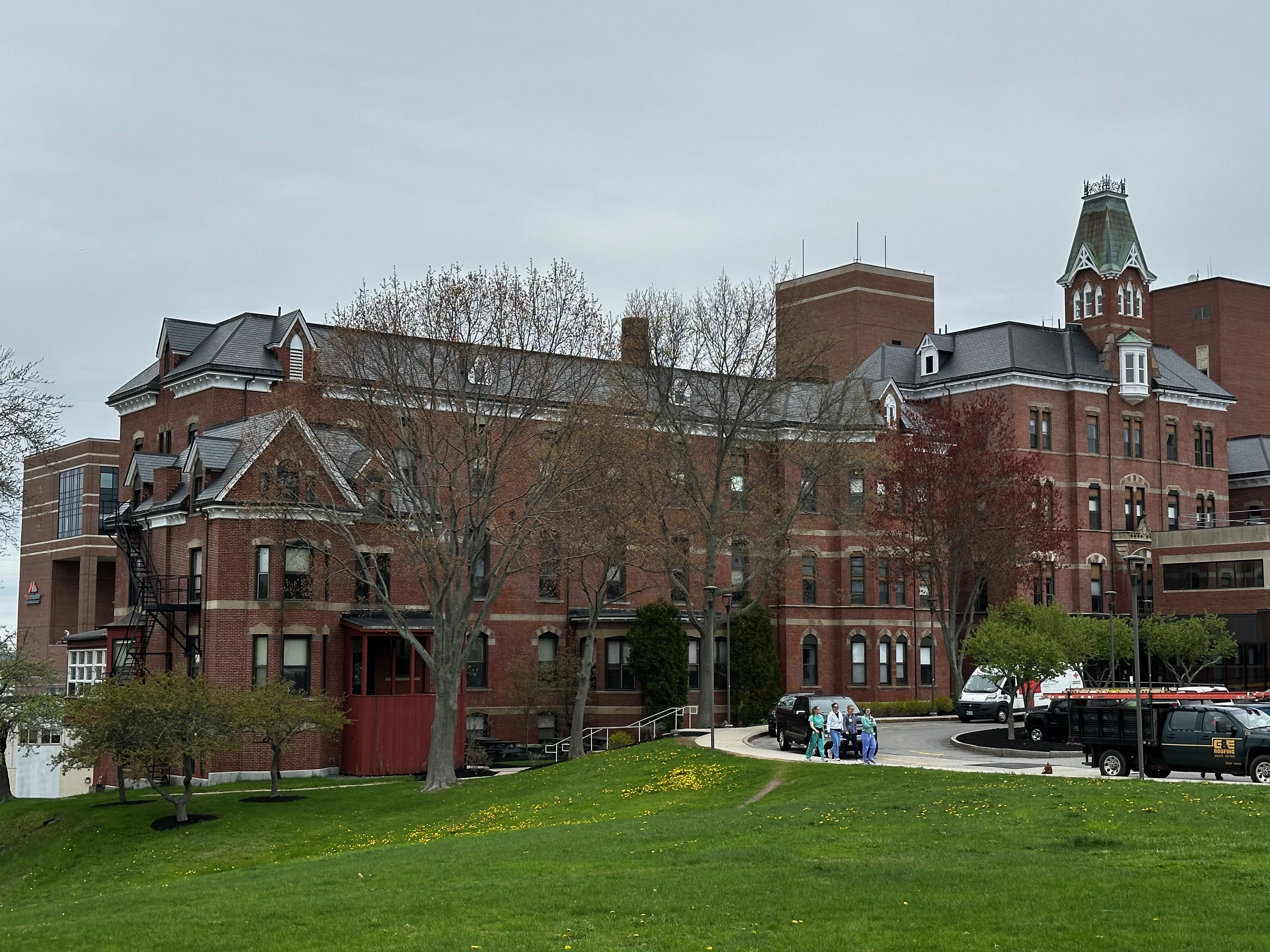
Maine Medical Center
22 Bramhall St. and the Western Prom
Maine Medical Center was founded at this location in 1874 as the Maine General Hospital. What is now known as Maine Med is the largest hospital in northern New England and is part of Maine Health. Because of the hospital’s prominence, it has been a focal point in battles around both AIDS care and gender-affirming care.
The AIDS Epidemic
In 1981, clusters of rare cancers and pneumonias were being found among gay men in Los Angeles, New York, and San Francisco. By the end of that year, more than 300 of them were dead of what would become known as AIDS.
Three years later, Maine Medical Center admitted their first AIDS patient. Skip Brushaber, who would become a co-founder of the AIDS Project in Portland, was a nursing student at the hospital that year: “I was doing clinical at Maine Med, and we had our first AIDS patient in Maine. I happened to be working on the floor where he was in isolation. You know the people who bring in your meal trays and set you up for your meals? For that patient, they would just put the tray on the tray table and kind of push it into his room, not caring whether he could reach it. I brought that to the attention of my instructor and she said, ‘well you know, that’s the hospital; don’t get into, you’re just a student here.’ But one day I had seen enough. I went in and I pushed the tray up to his bedside and set him up. I said ‘the guy needs to eat.’ I think he died pretty soon after that.”
Peter Prizer, another local gay activist, also worked at Maine Med during the early 1980s and reported that “the first patients suffered horrible, horrible abuse. Not discrimination, abuse.” In the absence of any effective treatments, those working in the hospital were afraid of exposure to the virus. As Prizer, who worked in the hospital lab explained, “I got the first tubes of blood from AIDS patients coming into the lab. They were in sealed boxes and you had to put on double gloves. One woman on the day shift, I didn’t know her well, she actually cut herself and she died of AIDS.”
In August of 1990, the AIDS activist group ACT UP Maine held a protest and “die in” outside the hospital to demand doctors stop the unethical practice of dumping or refusing to treat people with AIDS who had Medicaid coverage. Activists at the “Where’s the Care” protest smeared themselves with fake blood and “died” on the sidewalk while others in the group outlined them in chalk. One participant explained, “Health care is a right, not a privilege. People are dying while the medical establishment in Maine is stalling.”
The Gender Clinic
Since 2014, Maine Medical Center has been at the forefront of gender affirming care in Maine through a Gender Clinic. The Clinic offers assessments of, and support for, children and adolescents, and, more recently, for adults, experiencing gender dysphoria.
Before the Clinic existed, young people in Maine in need of services had to travel to Massachusetts for care at the nation’s first pediatric gender clinic, Gender Management Services, or GeMS, in Boston.
According to the founding director of the Maine Gender Clinic, Dr. Jerrold Olshan, the need for a clinic in this state was clear: “About half [of trans people] will consider suicide during adolescence. And so, our big goal, and what got me interested is, how do we help this population do better in the long run?”
In 2017, the Gender Clinic at Maine Med hired its first coordinator, Brandy Brown. As Brown observes, “Initially they thought it was just going to be a handful of people who needed help. But then they realized that there was a much greater demand than previously anticipated and a need for something beyond a loose collaboration. So, my first mission after I was hired was to make it an official clinic.”
The work of the Gender Clinic was controversial both within the structure of the hospital and outside it. Brown notes that “As in most institutions, there was institutional transphobia. There was also a lot of messaging around not wanting to compromise potential donors. One of my strategies to help the Gender Clinic grow was to make the program useful - and known - throughout the state. I figured that if everybody knew about it, it would be a lot harder to make it go away.”
In 2019, a renowned gender scholar, Dr. Anne Fausto-Sterling, gave the inaugural Grand Rounds for the Gender Clinic. According to Nancy Foss, who helped organize the event, it was enormously successful. The Grand Rounds “took place in the largest auditorium they have. It was absolutely packed and raucous with a sea of young clinicians of all types just so excited about a talk on gender and science.”
After years of internal collaboration, The Gender Clinic formally connected pediatric care with adult care in 2022 by bringing in Dr. Dan Spratt, an adult reproductive endocrinologist who had been supporting adult trans patients on his own for well over a decade before the merger. This allowed for a continuum of care to be offered throughout the lifespan.
That same year, in 2022, the Gender Clinic came to the attention of the far-right group “Libs of TikTok” which posted a critical tweet about it. Despite the harassment, the Clinic persisted. In the spring of 2024, the Maine Legislature passed a law increasing protections for transgender patients and providers in the state of Maine, including those who travel to Maine for medical care. As Brandy Brown observes “In 2024, we’ve seen something like 20 states that are banning trans care right now. So, I think the fact that the Gender Clinic continues to exist in Maine is really important.”
Photos
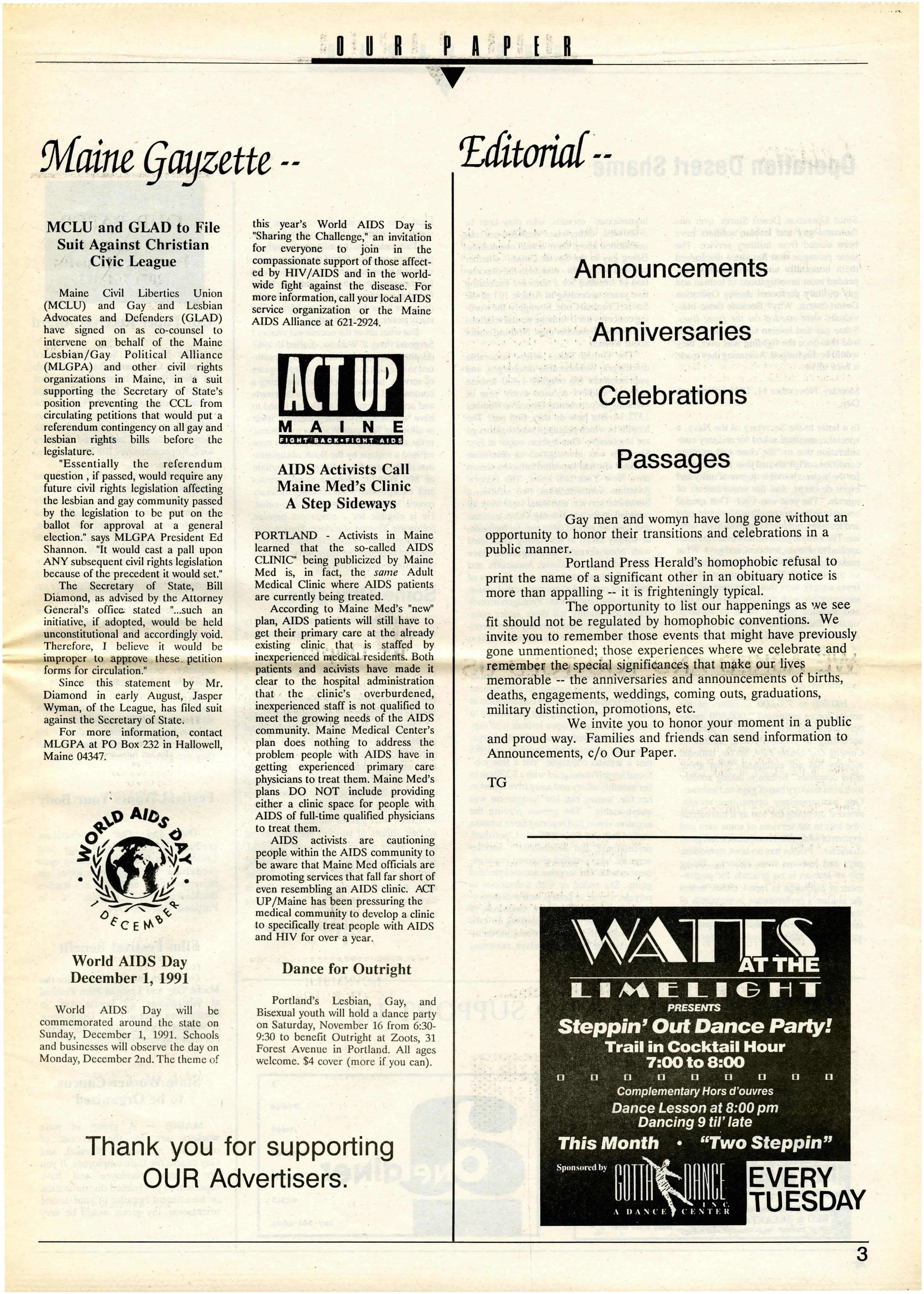
“AIDS Activists Call Maine Med’s Clinic A Step Sideways” Our Paper 11/1991 (1991). Our Paper (1983-1992). 3.https://digitalcommons.usm.maine.edu/our_paper_sac/3
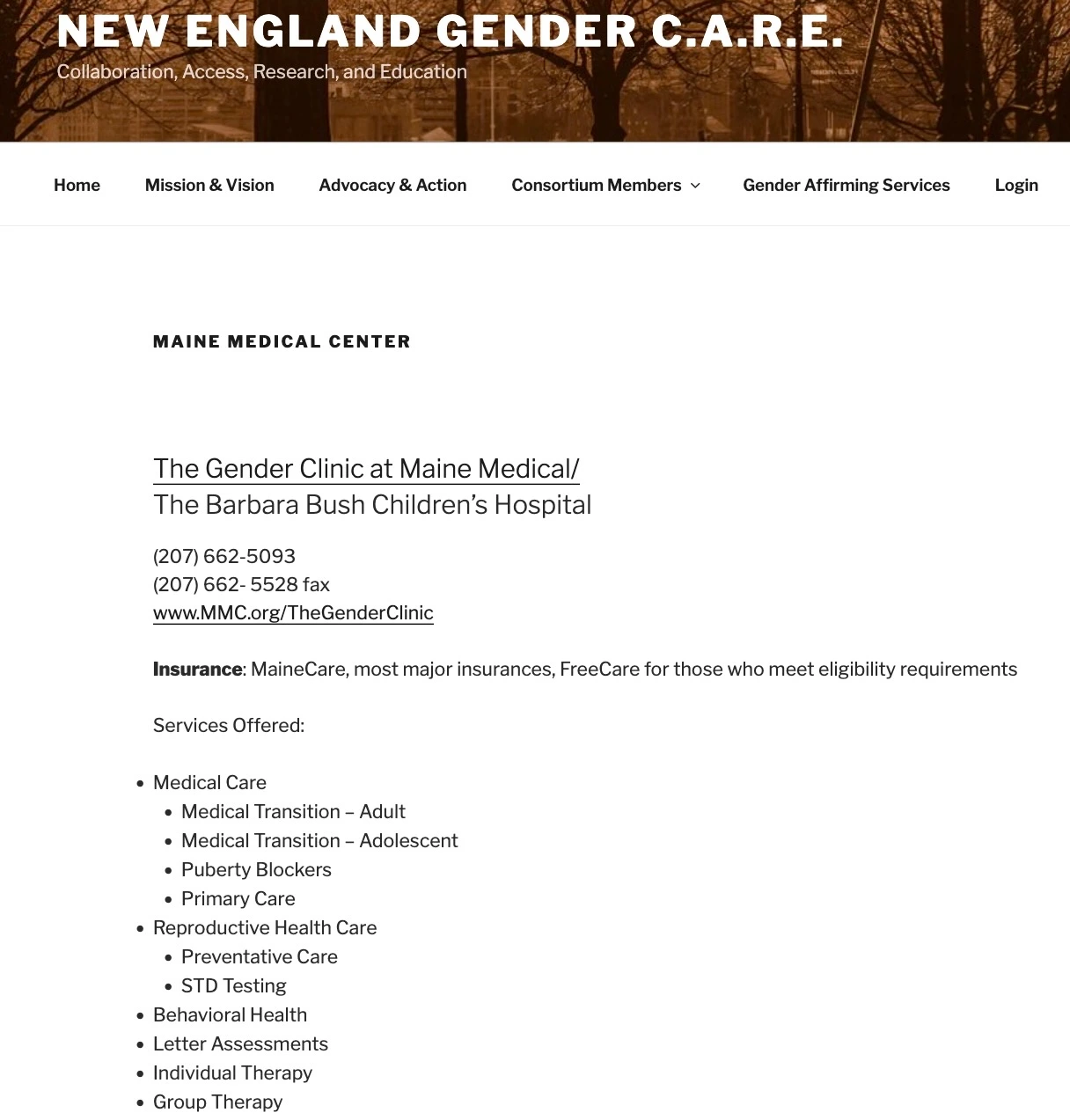
New England Gender Care website.
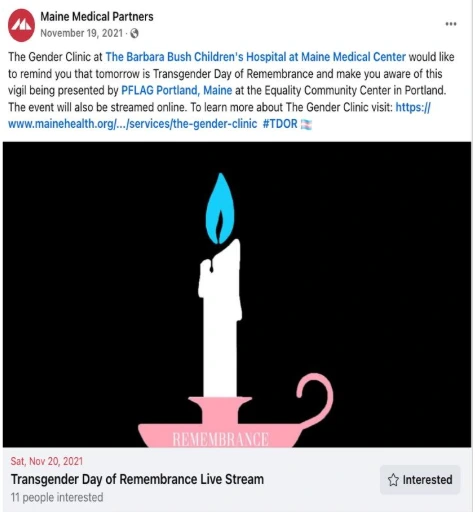
Gender Clinic and Trans Day of Rememberance social media event listing.
Hospital campus. Chapkis private collection.
Sources
Barrett, Jack and Pratt, Branden, “Brushaber, Skip” (2018). Querying the Past: LGBTQ Maine Oral History Project Collection. 33. https://digitalcommons.usm.maine.edu/querying_ohproject/33
Chapkis, Wendy, “Prizer, Peter” (2019). Querying the Past: LGBTQ Maine Oral History Project Collection. 48. https://digitalcommons.usm.maine.edu/querying_ohproject/48
Clarke, Talia. “Hearing held over bill to protect out-of-state transgender patients, Maine providers” (2024). WMTW television. March 5. https://www.wmtw.com/article/hearing-bill-protect-out-of-state-transgender-patients-maine-providers/60103516
Davis, Emma. “Maine shield law protecting reproductive, gender-affirming care takes effect Friday” (2024). Maine Morning Star. August 8. https://mainemorningstar.com/2024/08/08/maine-shield-law-protecting-reproductive-gender-affirming-care-takes-effect-friday/
Erickson, Ian. Honors Thesis Capstone Project, Bates College (2018). “You are not alone: HIV/AIDS activism in Maine.” May. https://scarab.bates.edu/cgi/viewcontent.cgi?article=1313&context=honorstheses
Foss, Nancy. 2024. Personal communication to Wendy Chapkis. January 9.
Martin, Atlantis, “Brandy Brown” (2024). Querying the Past: LGBTQ Maine Oral History Project Collection. __. [hyperlink]
New England Gender C.A.R.E. (Collaboration, Access, Research, Education), Mission Statement. https://negendercare.org/about/ (accessed January 16, 2025).
Sabol, Tracy. “Lucy’s story: Transgender children in Maine. Program at Barbara Bush Children’s Hospital helps guide transgender children” (2016). WMTW. February 11. https://www.wmtw.com/article/lucy-s-story-transgender-children-in-maine/2012085
Schemmel, Alec and Barton, Julian. “Maine Children’s Hospital Declines to Explain Gender Transition Services” (2022). Fox23 News. October 4. https://fox23maine.com/news/local/maine-childrens-hospital-declines-to-explain-gender-transition-services-barbara-bush-childrens-hospital-portland-maine
Wright, Penny. “Growing Need Prompts Maine Med to Open Gender Clinic” (2015). Maine Public Radio. March 4. https://www.mainepublic.org/maine/2015-03-04/growing-need-prompts-maine-med-to-open-gender-clinic